Scrambled Eggs
The most argued-over dish in any kitchen. The variables are heat, fat, agitation, and when to stop — and almost every great cook has a hill they will die on for at least one of them.
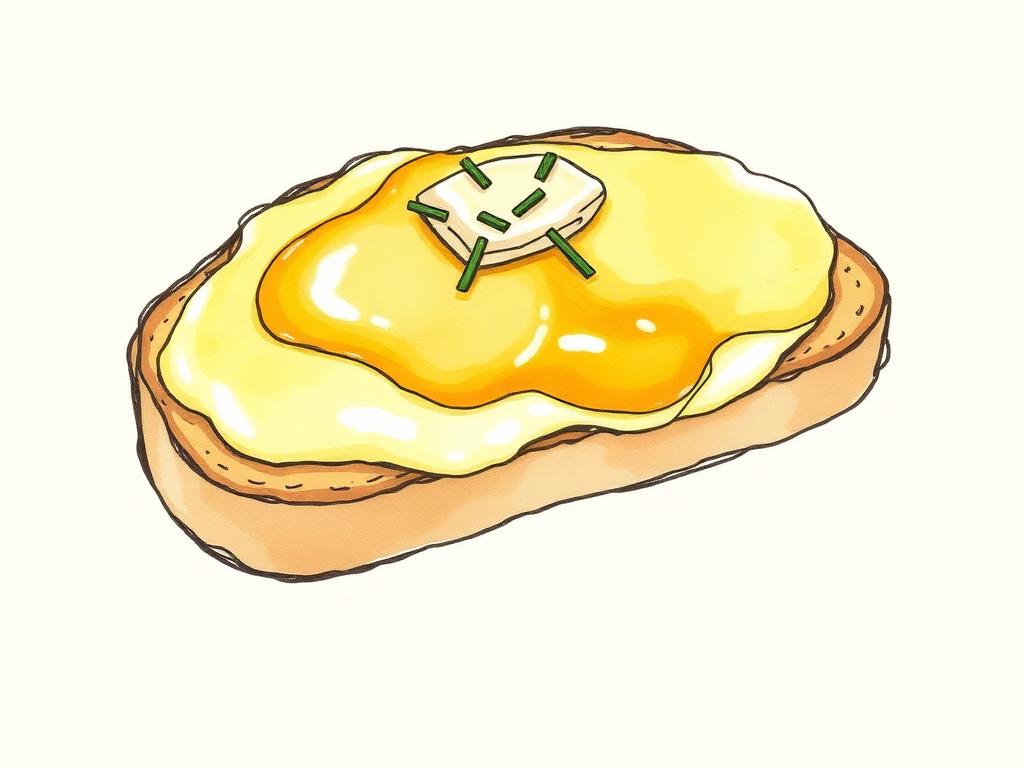
The Working Recipe
Ingredients
- Eggs3 large
- Cold unsalted butter, cubed20 g (1½ tbsp)
- Fine sea salta pinch (added at the end)
- Optional finishing: crème fraîche or cold butter1 tsp
- Optional: snipped chivesto taste
- Toast, to serve1 thick slice
Method
- 01
Crack the eggs into a cold non-stick pan. Add the butter cubes. Do not beat yet.
- 02
Place over low-medium heat. Begin stirring slowly with a silicone spatula, breaking up the yolks and pulling the egg from the bottom and edges as it sets.
- 03
Keep the eggs moving constantly. If the pan feels too hot, lift it off the heat for 5–10 seconds at a time and keep stirring — the residual heat does most of the cooking.
- 04
After 3–5 minutes, the curds should be small, glossy, and just barely holding shape. They should still look slightly underdone — they will keep cooking on the plate.
- 05
Off heat, season with salt and stir in the optional crème fraîche or a final cube of cold butter to halt cooking.
- 06
Slide onto warm toast immediately. Finish with chives and a few flakes of salt.
Synthesized by Cookbook Conversations as a baseline working recipe — closer to the French/Ramsay school. Other schools are in the margins. The conversation in the margins below is where the dish actually lives.
The Canonical Template
- 01
The Beat
Crack eggs into a cold pan or bowl and beat until uniform. Some cooks salt now to season throughout; others wait, fearing weeping.
- 02
The Heat
Apply heat — low and patient, or high and brief. The choice determines the curd structure of the finished egg.
- 03
The Agitation
Stir, fold, or push the egg as it sets. The more frequent the motion, the smaller the curd and the creamier the result.
- 04
The Stop
Remove from heat while still glossy and slightly underdone. Carryover heat will finish the cook in seconds.
The steps are the starting point. The conversation in the margins is where the dish gets argued.
The Arguments
Argument 01: Salt Timing
Salt the eggs before, during, or after cooking?
Gritzer's Serious Eats side-by-side test (5 batches, 0–60 minutes of pre-salting): the longer the salt sits with the beaten eggs, the more tender and moist the result. The kitchen lore that pre-salting toughens eggs is wrong.
— Daniel GritzerRamsay's published advice (and a long professional tradition) is to season at the moment of cooking or just after. Acting on instinct, not on a lab test.
— Gordon RamsayArgument 02: High vs. Low Heat
Slow and creamy, or fast and pillowy?
Ramsay's off-and-on saucepan method (and Child's double-boiler version) produces the small-curd, custardy egg that has become the modern standard.
— Gordon RamsayKenji's Serious Eats position: high-heat scrambled eggs cooked in about a minute are a complete dish in their own right and need no apology.
— J. Kenji López-AltArgument 03: Add a Stopper
Cream, crème fraîche, butter, or nothing?
Ramsay's published method ends with a spoon of crème fraîche stirred in off-heat: it halts the cook and adds a clean tang.
— Gordon RamsayBourdain (Tech Insider, 2017) argued against milk, cream, or any dilutant — eggs, butter, salt and pepper, nothing else. Stoppers cover for poor heat control.
— Anthony Bourdain