Bolognese
A ragu, not a sauce. A meat preparation in which tomato is a background note, not a headline. The argument is about restraint: how little tomato, how much milk, how long on the stove, and what shape of pasta has the right to carry it.
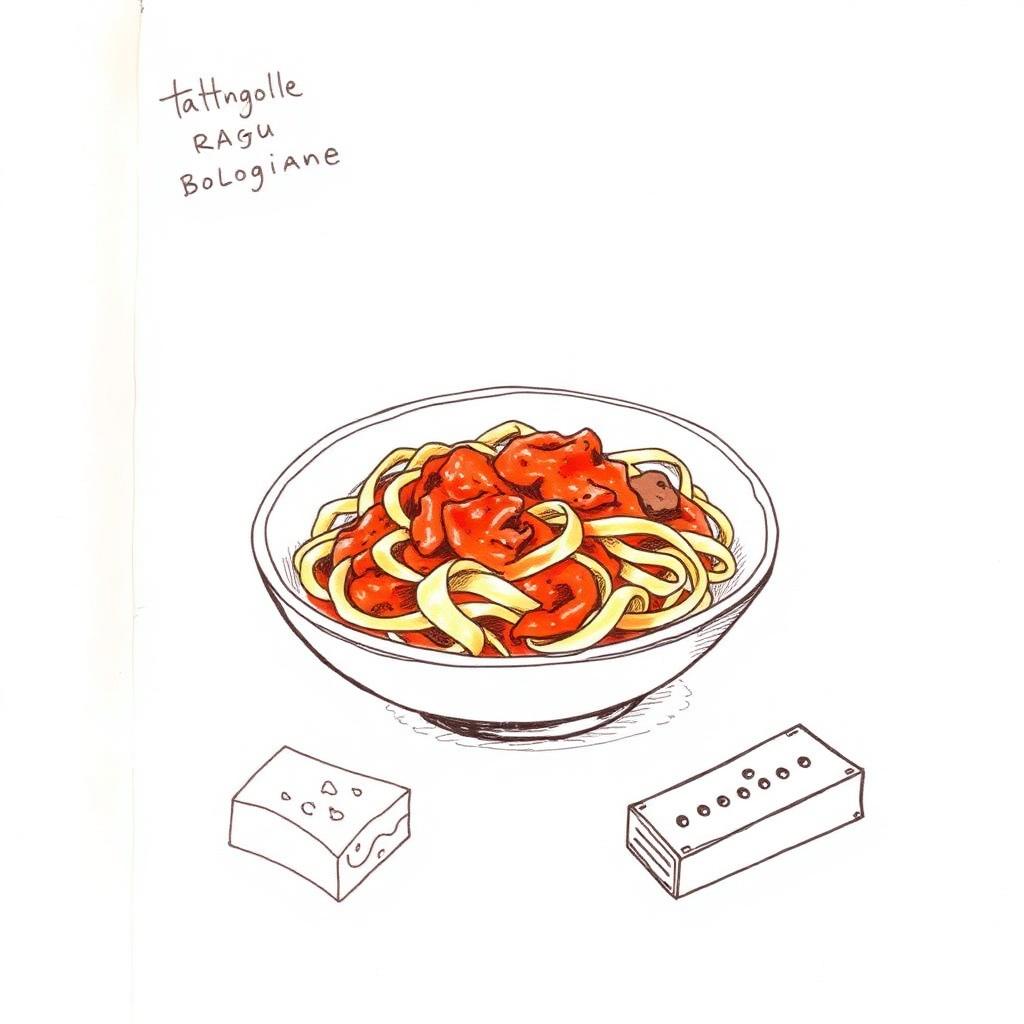
The Working Recipe
Ingredients
- Coarsely ground beef chuck (or beef + pork mix)500 g
- Pancetta, finely diced60 g
- Onion, finely diced1 medium (~120 g)
- Carrot, finely diced1 medium (~80 g)
- Celery, finely diced1 stalk (~60 g)
- Dry white wine200 ml
- Whole milk250 ml
- Tomato passata or crushed tomatoes200 g
- Beef or chicken stock300–500 ml, as needed
- Olive oil + butter1 Tbsp each
- Salt, pepper, freshly grated nutmegto taste
- Fresh tagliatelle400 g
- Parmigiano-Reggiano, gratedto finish
Method
- 01
Heat olive oil and butter in a heavy pot over medium-low. Add pancetta and render for 4 minutes. Add the soffritto (onion, carrot, celery) and sweat slowly for 15 minutes until soft and barely colored.
- 02
Push the vegetables to the side, raise the heat, and add the meat in clumps. Break it up only loosely and let it brown — patience here builds the base.
- 03
Pour in the wine and let it reduce almost completely. Add the milk and a grating of nutmeg; simmer until absorbed, about 10 minutes.
- 04
Add the tomato and a pinch of salt. Bring to a bare simmer.
- 05
Cook uncovered or partially covered on the lowest possible flame for 2–3 hours, adding stock a ladle at a time when it threatens to dry out. The finished ragu should be glossy, loose but not soupy.
- 06
Cook the tagliatelle to al dente. Toss directly in the pan with a generous spoonful of ragu and a splash of pasta water. Plate; finish with Parmigiano.
Synthesized by Cookbook Conversations as a baseline working recipe. The arguments around it are the actual study. The conversation in the margins below is where the dish actually lives.
The Canonical Template
- 01
The Soffritto
Sweat finely diced onion, carrot, and celery in fat over low heat until soft and translucent. Do not brown. This is the flavor base; rush it and the ragu has no foundation.
- 02
The Browning
Add coarsely ground beef (or a beef-pork mix). Let it sit and brown in the pan rather than stirring constantly. The fond it builds is half the dish.
- 03
The Liquids in Sequence
Deglaze with white wine and reduce. Add milk and let it absorb. Only then add a small amount of tomato. The order matters: each liquid does its own job.
- 04
The Long Simmer
Cook at the lowest possible flame for hours, adding stock or water as it tightens. The ragu is finished when the fat has separated and the meat reads almost as a paste.
The steps are the starting point. The conversation in the margins is where the dish gets argued.
The Arguments
Argument 01: Milk: Yes or No
Does dairy belong in a ragu?
Hazan's explicit instruction (Essentials, 1992): milk before tomato. The dairy tenderises the meat and rounds out the acid. The Accademia Italiana della Cucina's registered Bologna recipe also calls for it.
— Marcella HazanSkip the milk and let the meat and tomato meet directly. The texture is leaner and more honest to the cut (Elizabeth David, Italian Food).
— Elizabeth DavidArgument 02: Wine Color
Deglaze with white or red?
White wine lifts without dominating. It is what the Bolognese tradition — and Hazan's canonical recipe — specifies.
— Marcella HazanRed wine matches the heft of the beef and deepens the colour and flavour of the ragu (David, Italian Food).
— Elizabeth DavidArgument 03: Long Simmer vs. Pressure
Do four hours actually beat ninety minutes?
Hazan is unambiguous: no less than 3 hours, more is better. The meat needs time to break down and the fat needs time to render and separate.
— Marcella HazanKenji's Serious Eats recipe runs slow-roasted in the oven for around three hours but argues the meaningful gains plateau early; pressure-cooker bolognese (Serious Eats, 2015) approximates it in a quarter the time.
— J. Kenji López-AltArgument 04: Pasta Shape
Tagliatelle or spaghetti?
Wide, eggy ribbons that the meat can cling to — the traditional Emilia-Romagna partner. Spaghetti bolognese is essentially a British/American invention (Bastianich tradition).
— Lidia BastianichPappardelle, rigatoni, fettuccine all carry ragu well. The shape is convention, not law (Tucci's Taste).
— Stanley Tucci