Chocolate Chip Cookies
An exercise in hydration, fat behavior, and time. Almost every meaningful difference between a great cookie and a forgettable one comes from choices made before the dough sees the oven.
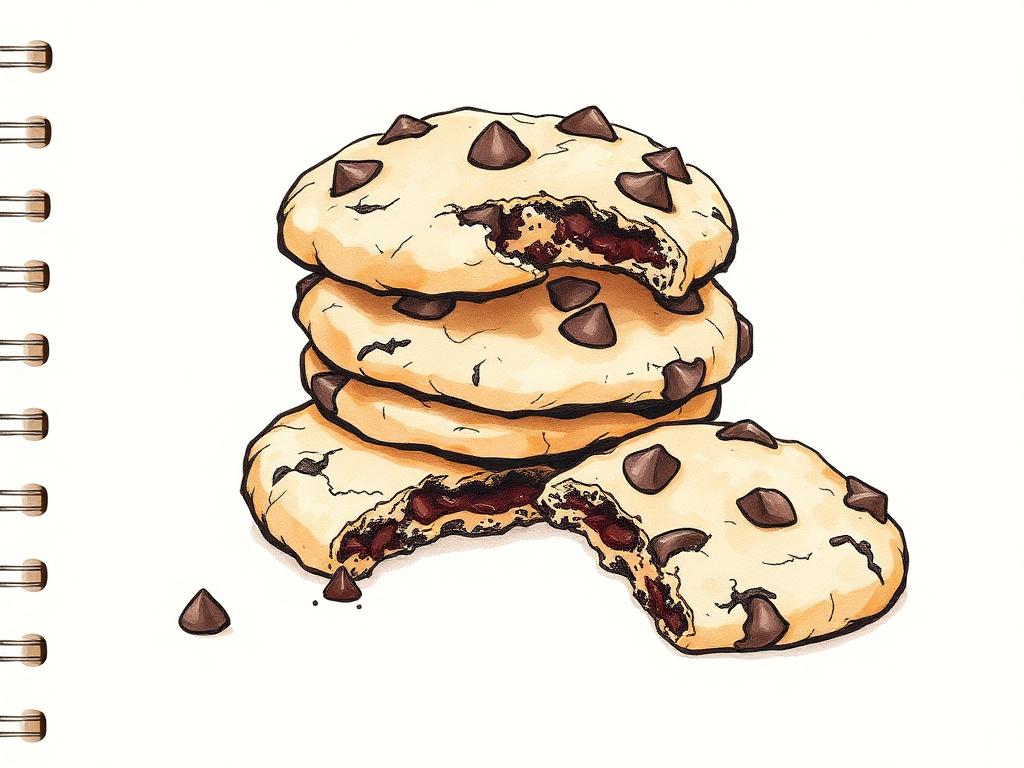
The Working Recipe
Ingredients
- All-purpose flour280 g (2¼ cups)
- Baking soda1 tsp
- Fine sea salt1 tsp
- Unsalted butter, browned and cooled to soft225 g (1 cup / 2 sticks)
- Dark brown sugar, packed200 g (1 cup)
- Granulated sugar100 g (½ cup)
- Eggs (1 whole + 1 yolk)1 large + 1 yolk
- Vanilla extract2 tsp
- Chopped dark chocolate (60–70%) and chips300 g (10.5 oz), mixed
- Flaky sea salt to finishto taste
Method
- 01
Brown the butter in a light-colored saucepan until it smells nutty and the milk solids are deep amber, about 5 minutes. Pour into a bowl and let cool to a soft, spreadable consistency (about 30 minutes).
- 02
Whisk flour, baking soda, and fine salt together in a separate bowl.
- 03
Beat the cooled brown butter with both sugars for 2 minutes until glossy. Add the egg, yolk, and vanilla; beat 1 minute more.
- 04
Fold in the dry ingredients with a spatula just until no streaks remain. Fold in the chocolate.
- 05
Scoop into 80 g balls (about ⅓ cup each), cover, and refrigerate at least 24 hours and up to 72.
- 06
Bake at 190 °C / 375 °F on parchment-lined sheets, 6 per sheet, for 11–13 minutes — the edges should be set, the center still pale and slightly underdone.
- 07
Bang the tray on the counter once out of the oven for the deflated, rippled edge. Hit each cookie with flaky salt while warm. Cool 10 minutes before moving.
Synthesized by Cookbook Conversations as a baseline working recipe — built around the 24-hour rest most pros agree on. The conversation in the margins below is where the dish actually lives.
The Canonical Template
- 01
The Fat Phase
Combine softened butter with brown and granulated sugars. Cream just enough to integrate; the more air worked in, the cakier the result.
- 02
The Hydration
Beat in egg(s) and vanilla until the dough looks satin and uniform. The water in the egg now begins to dissolve the sugar and start gluten formation.
- 03
The Dry Fold
Add flour, salt, and chemical leaveners and mix only until no streaks remain. Fold in chocolate by hand to avoid breaking it.
- 04
The Rest
Refrigerate the dough — minimum overnight, ideally 24 to 36 hours — to let the flour fully hydrate and the sugars draw moisture from the butter.
- 05
The Bake
Bake on light-colored sheets at high heat until the edges are set but the centers still look underdone. Carryover heat finishes the middle on the tray.
The steps are the starting point. The conversation in the margins is where the dish gets argued.
The Arguments
Argument 01: The Rest Period
How long should the dough rest before baking?
Per Leite's NYT testing, a 24–36 hour rest fully hydrates the flour, partially dissolves the sugars, and develops a toffee depth fresh dough cannot match.
— David LeiteGarten's home-cook position: a properly mixed dough does not need a day in the fridge to be a generous cookie. The wait is a restaurant move.
— Ina GartenArgument 02: Chips vs. Chunks
Engineered chocolate chips, or chopped bar chocolate?
Hand-chopped bar chocolate gives you fault lines, dust, and full-melt pools that engineered chips, designed to hold their shape, cannot deliver (Kenji, Serious Eats, 2013).
— J. Kenji López-AltChips hold their shape, distribute evenly, and give every bite a recognizable cookie experience — the engineered consistency is the point, not a flaw (Garten, 2012).
— Ina GartenArgument 03: Brown the Butter?
Should the butter be browned before creaming, or used soft?
Browning produces nutty, caramelised milk solids that change the whole flavour curve of the finished cookie — Kenji's Serious Eats testing is the most thorough published case for it.
— J. Kenji López-AltSoft, plain butter creamed with the sugars preserves chew and lets brown sugar do the caramel work (Saffitz, Dessert Person, 2020).
— Claire SaffitzArgument 04: Salt at the End
Flaky salt on top, or fully salted dough?
Flaky salt on top gives bursts of salinity that contrast the sweetness in a way mixed-in salt cannot (Saffitz, Dessert Person, 2020).
— Claire SaffitzSalt belongs in the dough, evenly. Top-salting is a finishing flourish, not a structural choice (Garten, Barefoot Contessa Foolproof, 2012).
— Ina Garten